EXPLAINED
GLOBAL AFFAIRS
Thursday, November 19, 2026
TRILATERAL SUMMIT 2026 – KYLIN VILLA, SHENZHEN
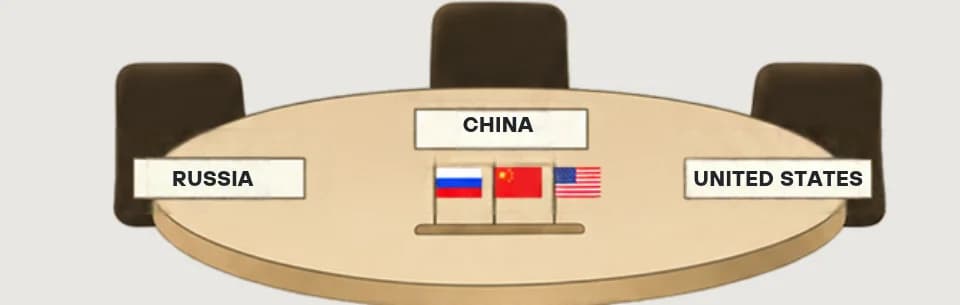
Three Superpowers, One Table: Trump, Putin and Xi Hold Historic Summit
An analysis of the first-ever trilateral meeting between the leaders of Russia, the United States and China, and its implications for global peace, nuclear security and international relations.
ILLUSTRATION
AT A GLANCE
- meeting of the three countries’ leaders together
- 1st
- points in the joint “Declaration Towards Peace”
- 4
- USA
- 5,000+
- Russia
- 5,000+
- China
- 600+
Lower-bound estimates as reported by AP. New START, the last US–Russia arms pact, expired in February 2026.
The Bigger Picture
The United States, China and Russia are the world's three largest nuclear powers and permanent members of the UN Security Council. Until this, their leaders had never met together as a trio.
The meeting came at a tense moment. The US is at war with Iran, and attacks in the Strait of Hormuz have pushed up energy prices. Russia’s war in Ukraine continues. Trump had said for weeks that he wanted to discuss the war and denuclearisation with both leaders, and China, as this year's APEC host, brought them together in Shenzhen.
THE ROAD TO SHENZHEN
FEBRUARY 2026: New START, the last US–Russia nuclear arms pact, expired.
NOVEMBER 2026: The leaders confirm the first-ever three-way meeting at Kylin Villa with a four-point joint declaration.
The Historic Summit
On 19 November, Xi hosted Trump and Putin at Kylin Villa for talks the Chinese state media said lasted about 90 minutes. Beforehand, Trump had separate meetings with Xi (about an hour) and Putin (about 40 minutes).
Donald Trump: “We are really making history.”
Said the three share 'joint responsibility'" for international peace.
Xi Jinping: Called the meeting a “groundbreaking event.”
KEY DEVELOPMENTS
Nuclear Security: Dialogue to reduce nuclear risks and prevent proliferation; nuclear war “must never be fought.”
UN Reform: Commitment to reform the UN so it responds more effectively to global challenges.
Energy Cooperation: Pledge to increase production and supply of reliable, affordable energy.
International Relations: Commitment to maintaining a stronger, stable and fair international security.
Global Impact
International politics: The talks reopen top-level contact among the three powers: Ukraine and its European allies, absent from the table, have voiced concern about being sidelined.
Energy markets: The full pledge targets a market strained by attacks in the Strait of Hormuz. No sudden or destabilising turns were announced.
Nuclear security: Dialogue is a first step, not a treaty. China’s far smaller arsenal gives Beijing an incentive to accept limits, while Trump seeks a new deal that includes China.
Major-power relations: The declaration also backed immunity for state officials and warned the International Criminal Court, which has a warrant out for Putin, against abusing its jurisdiction.
Unresolved Challenges
The summit produced no settlement on the Russia–Ukraine war or the Iran conflict. The declaration did not mention either war, though Trump said he was also on his own in one-on-one talks with Putin. There was also no undertaking to end the Ukraine war, and renewed calls for talks with the US–China trade truce due to expire by 10 January 2027.
What we
learned
01
Cooperation among major powers can influence global stability.
02
Nuclear security remains a shared international responsibility.
03
Diplomatic agreements do not necessarily resolve ongoing conflicts.